

About Us
Carrying forward one of its original historic names, The Parthenon returns to downtown New Albany as a reimagined venue for modern celebrations. Opening in early 2026, the restored landmark blends timeless architecture with refreshed design and amenities. From weddings and private events to community gatherings and creative workshops, every detail honors its storied past while welcoming a new chapter.
Customizable Space
Host everything from birthday celebrations to reunions, showers, fundraisers, and more. Our flexible layout allows you to tailor the atmosphere and setup to your event’s needs.
Corporate Events
From team meetings to large-scale gatherings, our space offers a professional yet inviting environment. With flexible setup options and modern amenities, it’s designed to help your group connect, collaborate, and celebrate success.
Wedding Venue
Say “I do” in a setting that feels timeless and intimate. Whether you’re planning a grand celebration or a small ceremony, our versatile venue provides the perfect backdrop to bring your vision to life.
Weekly Rental
Ideal for recurring classes, workshops, and gatherings - our venue offers flexible weekly rentals for groups such as fitness, art, or music. Enjoy a creative, comfortable setting designed to inspire connection and consistency.
THE
HISTORY OF
EST. 1837
203 E MAIN
NEW ALBANY, IN

Origins and Construction (1830s)
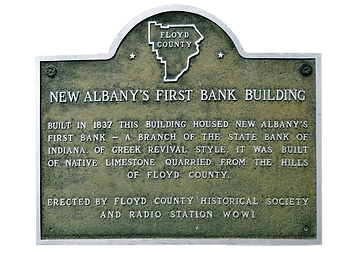
Built in 1837, the stately Greek Revival building at 203 East Main Street is one of the most architecturally significant landmarks in New Albany. Designed by Hugh Pugh, it served as the New Albany branch of the State Bank of Indiana, one of the earliest purpose-built bank structures in Southern Indiana.
Carved from Floyd County limestone, its four Doric columns, triglyphs, and pediment evoke the look of The Parthenon in Athens, which inspired its classical design. The main hall originally featured a two-story domed ceiling and skylight, with natural light filtering through the top rather than windows. Later, a second floor and side windows were added to make the space more practical for daily use.
At the time, the State Bank of Indiana was a sign of progress and stability for a growing river town whose shipbuilders, merchants, and craftsmen powered the local economy. This building symbolized that confidence, a temple to prosperity and order in the young state’s booming trade corridor along the Ohio River.

Banking and Prosperity (1837–1897)
The State Bank of Indiana operated here for decades before reorganizing in 1863 as the First National Bank, continuing until 1897. Presidents William S. Culbertson and later his son Samuel helped shape New Albany’s financial and civic landscape.
By the 1890s, however, the banking industry faced deep challenges. The Panic of 1893 and subsequent economic stagnation hit New Albany hard, slowing trade and manufacturing. With fewer loans being issued and excess cash on hand, the First National Bank’s directors voted to dissolve the institution, closing the institution.
It marked the end of the building’s first life: from a temple of finance to a relic of a city in transition.
New Purposes in a Changing City (1900–1940)
After standing vacant for a few years, the building adapted to the city’s shifting needs:
-
1904–1907: Used by the Marion County Construction Company during New Albany’s street-paving boom, when brick and macadam roads reshaped the city’s infrastructure.
-
1907–1916: Purchased by the First Church of Christ, Scientist, transforming the bank into a serene house of worship. The grand domed ceiling suited its spiritual symbolism.
-
1916–1941: Sold to the Knights of Pythias, who renamed it Pythian Temple, also known as Castle Hall. In this period, New Albany, like many industrial towns, was recovering from World War I and the 1917 tornado. Fraternal orders became community anchors, and the building hosted meetings, social clubs, and Saturday-night dances.
By the late 1920s and 1930s, as jazz and swing gained popularity, the building’s grand first floor was used for public dances and gatherings. However, the Great Depression and later World War II brought stricter social conservatism and new forms of entertainment. The dances faded, and the building, already aged and expensive to maintain, shifted toward civic service once again.

The Red Cross Era (1941–1982)
In 1941, the New Albany Chapter of the American Red Cross acquired the property with help from the local YMCA trustees. Under the direction of Dr. A. P. Hauss, the building was completely renovated to serve as a local headquarters for wartime aid.
The Red Cross used the second-floor dome room as a first-aid training center, while volunteers worked below in what had once been the main banking hall. The chapter remained in the building for over forty years, weathering floods, storms, and economic shifts. By the 1970s, the limestone façade had begun to crumble, but the structure remained solid, a testament to 19th-century craftsmanship.
It was during this time that preservationists began recognizing 203 E Main as one of only three surviving State Bank of Indiana branches (along with Terre Haute and Vincennes).

The Parthenon
The vacant temple found new life as an event hub:
-
Early 2000s: The structure was reopened as The Parthenon, honoring its Greek Revival heritage. Operated as an event and arts venue, it hosted weddings, small concerts, art shows, and creative workshops, becoming a beloved local gathering place once more.
This period cemented the building’s identity not just as an artifact, but as a living cultural landmark, an anchor of Main Street’s revival. Later turning into a theater and then private use.
In 2025, 203 E Main Street was purchased, bringing a new vision and commitment to preserving its legacy while enhancing its beauty for the next century. Reopening again as The Parthenon, the building is being restored as a premier event venue, celebrating both its history and its rebirth.
Every room is being lovingly updated:
-
The second-floor dome now gleams with gilded stars, a celestial nod to its Greek inspiration.
-
The Observatory, a new gathering room lined with bookshelves, invites conversation and reflection.
-
Swarovski crystal chandeliers throughout the first floor to illuminate the interior with warmth and grandeur.
The Parthenon once again stands as a place of community, creativity, and celebration, just as it has for nearly two hundred years. From the sound of coins and typewriters to hymns, laughter, music, and vows, its walls have witnessed every rhythm of New Albany life.
